
Euploid Embryo Outcomes by Age at Oocyte Retrieval and Embryo Day
Just like non PGT-A tested embryos, pregnancy rates for euploid embryos vary by age at oocyte retrieval and the day at which the embryo was expanded enough to undergo biopsy and cryopreservation (Day 5, Day 6, or Day 7). One caveat is that typically embryos are cryopreserved at an expansion stage of 3 (full blastocyst) if they are not undergoing biopsy or 4 (expanded blastocyst) if they are undergoing biopsy. Expansion stage requirements for cryopreservation may vary slightly from laboratory to laboratory.
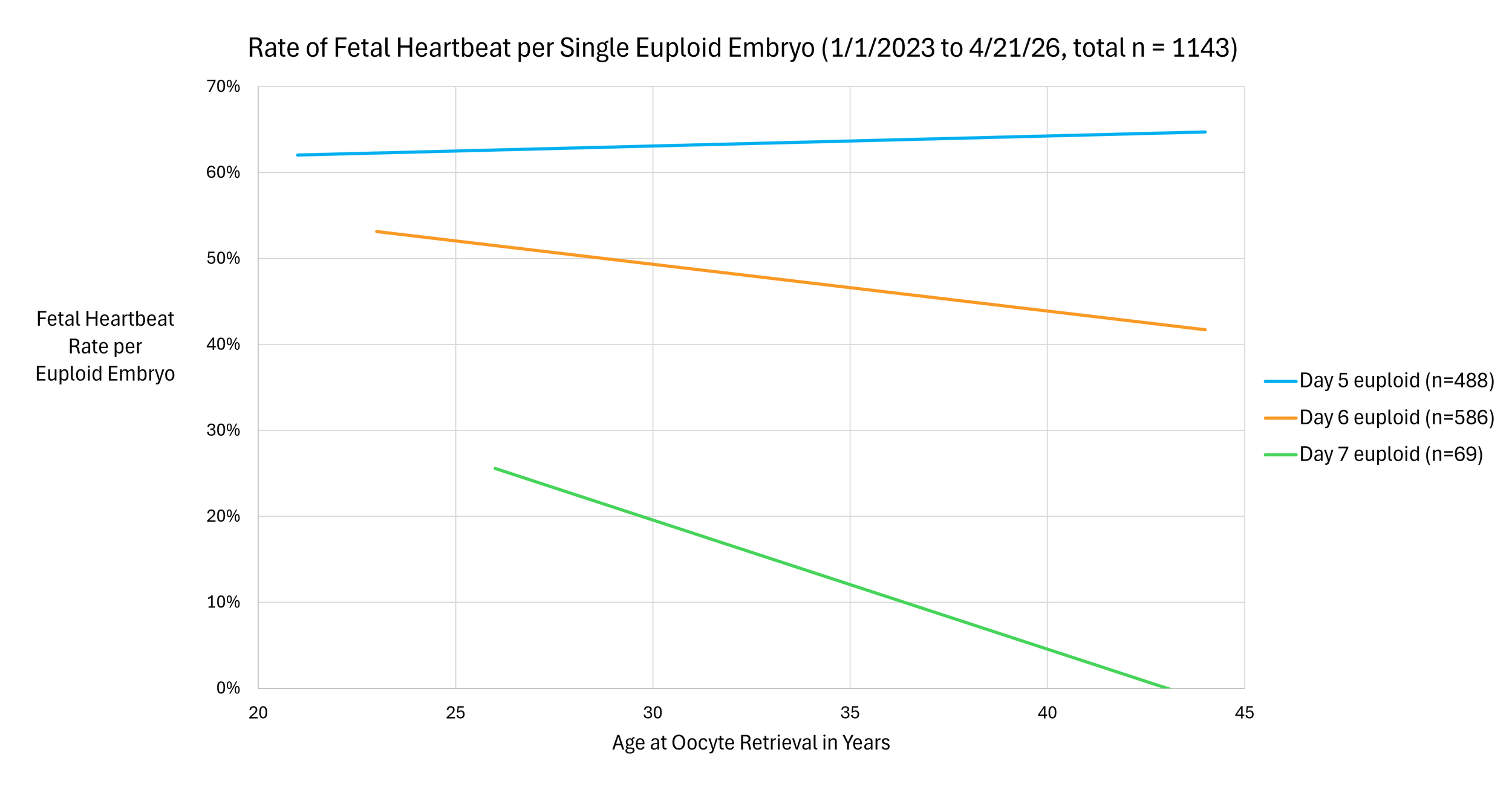
The data above is from our single clinic data from outcomes of single euploid embryo transfers. The overall fetal heartbeat rate was 64% (310/488) for day 5 euploid embryos, 47% (275/586) for day 6 euploid embryos, and 12% (8/69) for day 7 euploid embryos.
How do pregnancy rates from euploid embryos compare to non PGT-A tested embryo pregnancy rates?
We can compare our single clinic euploid embryo transfer data to published SART (Society for Assisted Reproductive Technology) data from the United States from 2016 to 2018 in the following publication.
Awadalla MS, Ho JR, McGinnis LK, Ahmady A, Cortessis VK, Paulson RJ. Embryo morphology and live birth in the United States. F&S Reports. 2022 Jun 1;3(2):131-7.
To go between “live birth” in the published SART data to “fetal heartbeat” rate, we assume that for non PGT-A tested embryos when there is a heartbeat we will have a live birth 85% of the time. For euploid embryos a fetal heartbeat seen on ultrasound results in a live birth approximately 93% of the time. Therefore, a live birth rate of 45% for a non PGT- A tested embryo corresponds to a 53% fetal heartbeat rate (0.45 / 0.85 = 0.53). With this correction we can create the graph below which is an approximation since we are comparing single clinic data from 2023 to 2026 for euploid embryos to non PGT-A tested embryos from the United States from 2016 to 2018. Our clinic is currently compiling our data for non PGT-A tested embryos at this time. Therefore, for the time being the SART data can be used to make a general comparison.
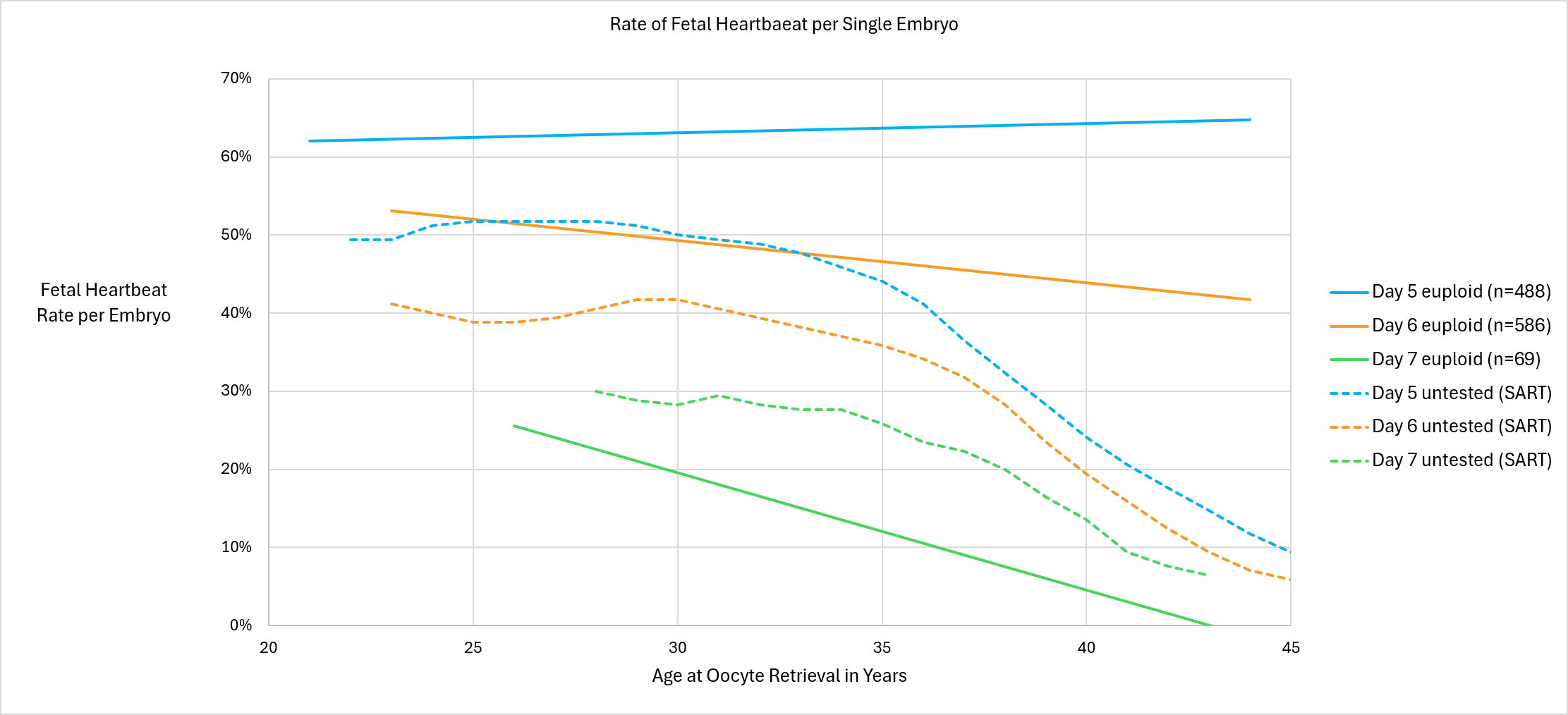
Euploid embryos biopsied on day 5 and day 6 had higher pregnancy rates than non PGT-A tested embryos that were cryopreserved on corresponding days. More data is needed on day 7 embryos. The euploid embryo data is from a single center from 2023-2026 and the untested embryo data is from clinics across the United States reporting to SART in 2016-2018 so the data is not directly comparable but more of a rough comparison.
