
Prolactin Reference Range for Women
Reproductive age women have higher prolactin values than the rest of the population. It is important to use a prolactin reference range specific for reproductive age women to avoid unnecessary pituitary MRI scans. We find a typical 95% reference range of 4 to 44 ng/mL for non pregnant reproductive age women. Reference ranges for a population that is not broken down by sex often may be listed as 5 to 25 ng/mL which would result in much unnecessary workup for women with normal prolactin values by the reference range specific to women.
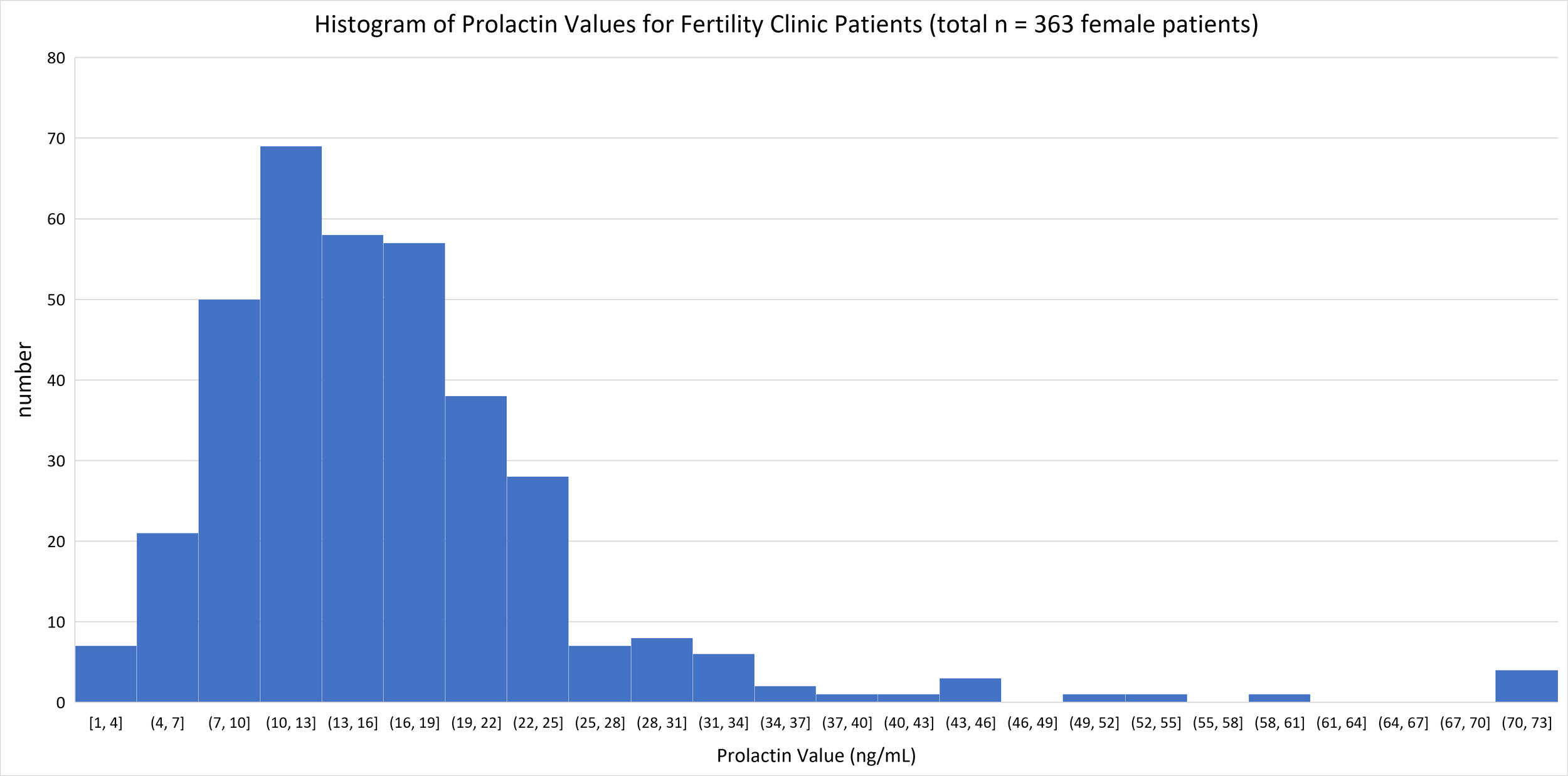
In the histogram above four values above 70ng/mL have been recorded as 70ng/mL to avoid stretching the graph horizontally and obscuring detail at the lower values of prolactin. We find a typical 95% reference range of 4 to 44 ng/mL for non pregnant reproductive age women.
More data is needed to determine if women with prolactin values slightly above the 95% reference range need additional workup or not (such as repeated fasting prolactin values or pituitary MRI scans). This would entail detailed review of any actionable clinical findings for women with elevated prolactin values. For many women with elevated prolactin values and pituitary microadenomas (a small benign lesion less than 10mm in size), typical treatment such as cabergoline or bromocriptine would be recommended regardless of finding a pituitary microadenoma or not.
Finding a microadenoma may prompt a repeat follow up MRI. It would also give a cause for the elevated prolactin.
Pituitary macroadenoma (greater than 10mm) would be more clinically important to detect on MRI. For macroadenoma visual field testing could be considered and checking other pituitary hormones.
On the other hand, it might be reasonable to simply check a pituitary MRI for all patients with persistently elevated prolactin. This would be about 5 patients a year or so per fertility clinic.
